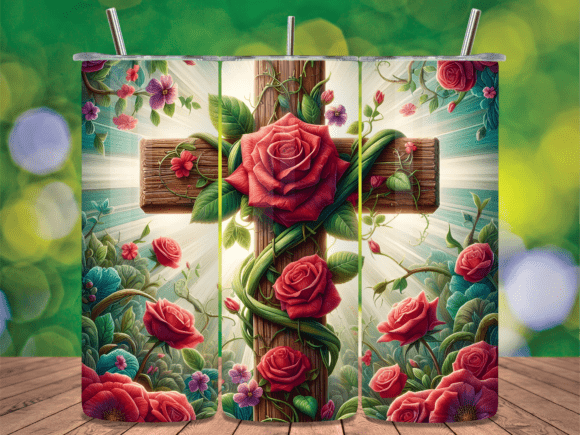
Christian Cross Red Rose Tumbler Wrap
A Quiet Moment of Faith and Craft—Before the Needle Moves
When I first opened the Christian Cross Red Rose Tumbler Wrap, I didn’t see a “design”—I saw a mood. A soft reverence, not loud or ornate, but grounded in balance: the vertical strength of the cross, the gentle curve of the rose stem, petals unfurling with quiet intention. It’s not overly detailed—no micro-petals or fragile filigree—but it doesn’t need to be. This is a design that breathes on fabric, not one that fights it. I immediately pictured it stitched onto a natural linen tea towel for a pastor’s retirement gift, or centered on a cream cotton apron for a faith-based kitchen boutique.
Where It Lives Best—Real Projects, Not Just Pixels
The Christian Cross Red Rose Tumbler Wrap isn’t built for flash—it’s built for meaning. In practice, it shines brightest on stable, medium-weight fabrics where stitch clarity matters more than speed: think embroidered tote bags for church volunteers, baby onesies with gentle red thread on ivory knit, or pillow covers for nursery decor. I recently tested a similar layout (same proportion, same flow) on a lightweight cotton sweatshirt—and the cross held its shape beautifully, while the rose retained soft definition without bleeding into the fill. No puckering. No lost detail in the petal edges. That tells me the stitch density is thoughtfully calibrated—not too sparse to look thin, not so dense it overwhelms delicate fibers.
It also works well as an embroidered patch. The outer edge is clean and closed, making it easy to trim and fuse. For Etsy sellers offering personalized gifts, this design fits seamlessly into collections like “Faith-Based Baby Bundles” or “Quietly Spiritual Home Goods.” Its visual weight sits comfortably between bold graphic embroidery and whisper-thin monograms—making it versatile for both men’s and women’s items without leaning into gendered clichés.
Where to Pause—and Stitch With Intention
That said, the Christian Cross Red Rose Tumbler Wrap asks for thoughtful placement. On highly textured fabrics—like bouclé knit or heavy terry cloth—the rose’s subtle curves can blur. On stretchy fabric (think performance tees or ribbed baby caps), you’ll need excellent stabilizer support underneath and possibly a light topping to keep satin-stitched petal edges crisp. And if you’re stitching it on dark fabric, test your red thread choice carefully: some “true reds” dull on navy or charcoal, losing warmth. A slightly orange-leaning red often reads richer against deep backgrounds.
Don’t force it into tiny hoops. While it scales down, the center cross and rose junction needs breathing room—below 3.5 inches wide, the negative space tightens and the design begins to feel cramped, not contemplative. Likewise, avoid layering it over seams or curved surfaces like baseball cap fronts unless you’ve pre-tested hooping stability. The vertical orientation works elegantly on flat panels, but ask yourself: does this surface *support* stillness? A tumbling mug wrap might be its namesake use—but its soul belongs on something held, touched, gifted.
What It Adds—Beyond Thread and Fabric
This isn’t just another machine embroidery design. It adds quiet authority to handmade product listings. When customers scroll past dozens of floral or script-based designs, the Christian Cross Red Rose Tumbler Wrap stands out by virtue of restraint. It signals care—not just in execution, but in intention. That builds trust, especially for faith-centered small shops or custom gift businesses where buyers are choosing more than aesthetics; they’re choosing resonance.
Visually, it balances symbolism and softness—critical for modern religious embroidery. No heavy gothic fonts, no stiff heraldry. Just a cross rooted like a stem, a rose blooming beside it. That duality makes it work across generations: young moms ordering nursery decor, older couples commissioning anniversary towels, church staff sourcing volunteer appreciation items. It feels personal without being private, reverent without being remote.
Practical Notes Every Designer Should Check First
- Test on scrap fabric first—especially if using cotton-linen blends or low-thread-count knits. Watch how the rose’s outer satin stitch settles.
- Review stitch density in your embroidery software. If it’s above 18,000 stitches, consider simplifying petal fills for high-wear items like tote bags or aprons.
- Confirm hoop size compatibility. While it fits standard 4x4 hoops at full scale, resizing may shift registration—always recheck alignment before batching.
- Inspect small details at 200% zoom: the tip of the cross, the curve where stem meets bloom. Are running stitches smooth? Do fill areas transition cleanly?
- Test black-and-white mockups. Does the design retain legibility and grace without color? If yes, it’s strong structurally—not just chromatically.
- Use cutaway stabilizer for knits, tear-away for wovens. Skip the topping unless stitching on fleece or plush—this design doesn’t need gloss, just clarity.
- Verify licensing before selling finished products or bundling the digital embroidery file. If it’s labeled for personal use only, don’t list it as part of an Etsy embroidery kit.
Final Thought—A Design That Waits Well
The Christian Cross Red Rose Tumbler Wrap doesn’t shout. It waits—in the hoop, on the screen, in the quiet space before the first stitch drops. That patience is its strength. Used right, it elevates a simple kitchen towel into a keepsake, turns a plain tote into a statement of gentle conviction, and gives small shop owners a design that feels both timeless and freshly relevant. It won’t win awards for complexity—but it will earn repeat orders, heartfelt thank-yous, and the kind of quiet confidence that comes from knowing your embroidery says exactly what it means to say.